$0.99 per outcome: notes on AI agent business ideas
AI agent business ideas for 2026, sorted by how they get paid, with verified adoption, token-cost and cancellation data, and a 20-job test before you price.
Contents

A receipt prints only for the outcomes that worked. Image: Towfiqu barbhuiya / Unsplash.
Intercom charges $0.99 each time its Fin agent resolves a support conversation, with a minimum of 50 a month. When Fin gets one wrong, the customer pays nothing. Intercom still pays for the tokens.
I went back through the adoption and cost data to see what that price means for anyone starting out, and rewrote our list of AI agent business ideas around it.
What counts as an AI agent business?
AI agent business ideas are ways to get paid for work an agent does on a customer's behalf, where the seller, not the customer, answers for the result.
Demand is real but uneven. In LangChain's survey of 1,340 practitioners, 57% had agents in production, and 50% of organisations under 100 people did. Across all US businesses, the Census Bureau put any AI use at 19.8% in May 2026, and under 20% for firms of four or fewer people.
That gap is the one I would sell into: small firms that want the work done and will never build the agent themselves.
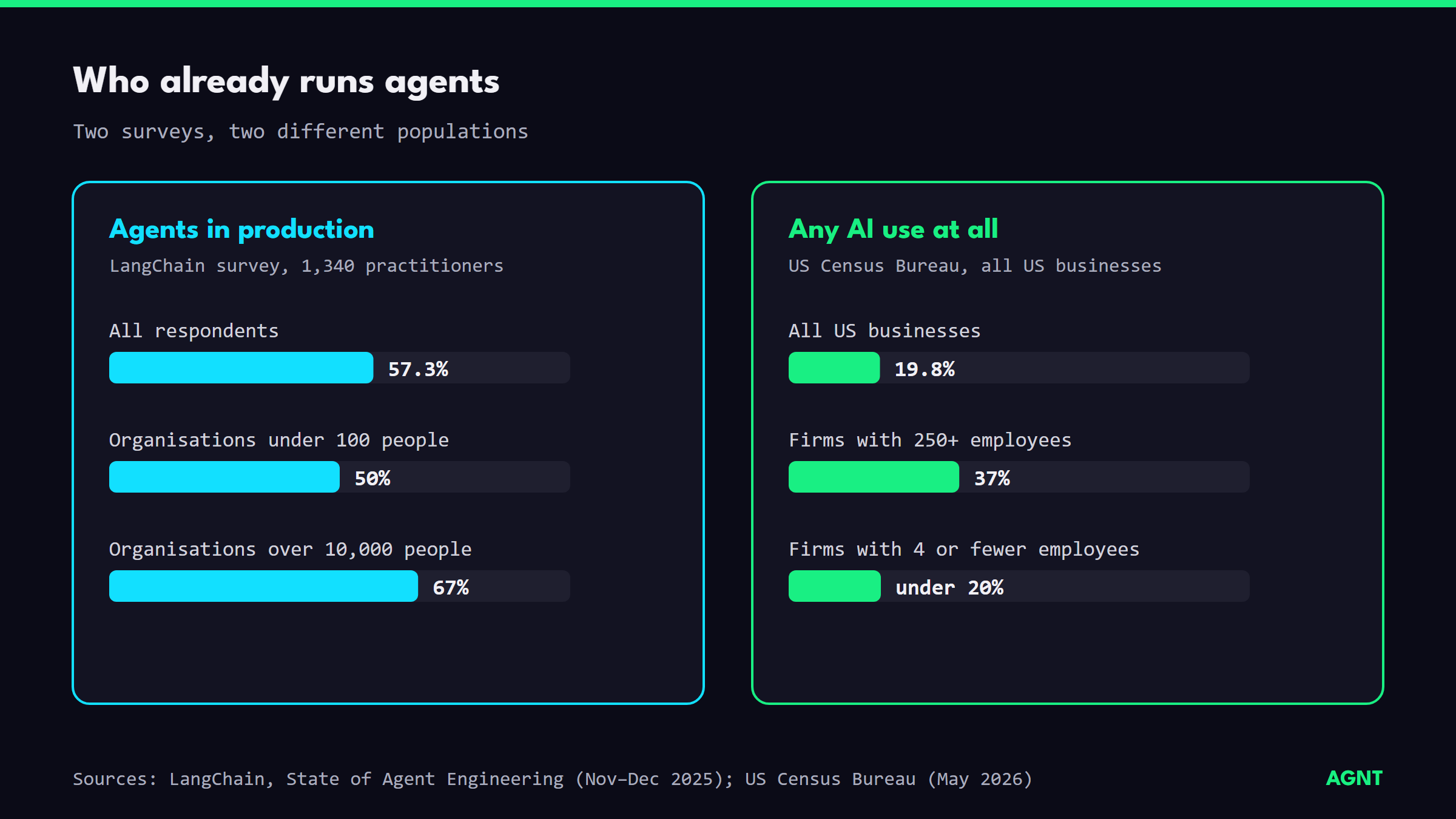
LangChain asked people already building agents. The Census asked every business, about AI of any kind.
AI agent business ideas, by how they get paid
Services pay soonest, because you sell hours you can start on this week:
- Vertical automation agency: the same three automations, sold to one industry you know.
- Agent reliability audits: score 20 to 50 real cases and fix what fails.
- Support deflection for small shops: answers from policies and orders, hands off the rest.
- Research briefings: a weekly sourced brief on one niche, every line linked.
- Content pipelines: research, draft and fact-check, with the client approving everything.
- Lead enrichment: research and score each inbound lead into the client's CRM.
Products take longer to earn but keep selling after the build:
- Templates: a working automation sold on a marketplace. Test it on a clean install.
- Outcome-priced vertical agents: one job, such as construction invoices, billed per result.
- Tools and MCP servers: a clean interface to a niche system with a poor API.
- Niche evaluation: checks a generalist can't write, such as "did this summary miss a deadline?"
Operator plays mean you run the agents yourself and sell the result:
- One-person agency: agents handle your prospecting and reporting, so headcount stays flat.
- Internal ops as a service: invoicing and reconciliation for several small firms, reviewed by you.
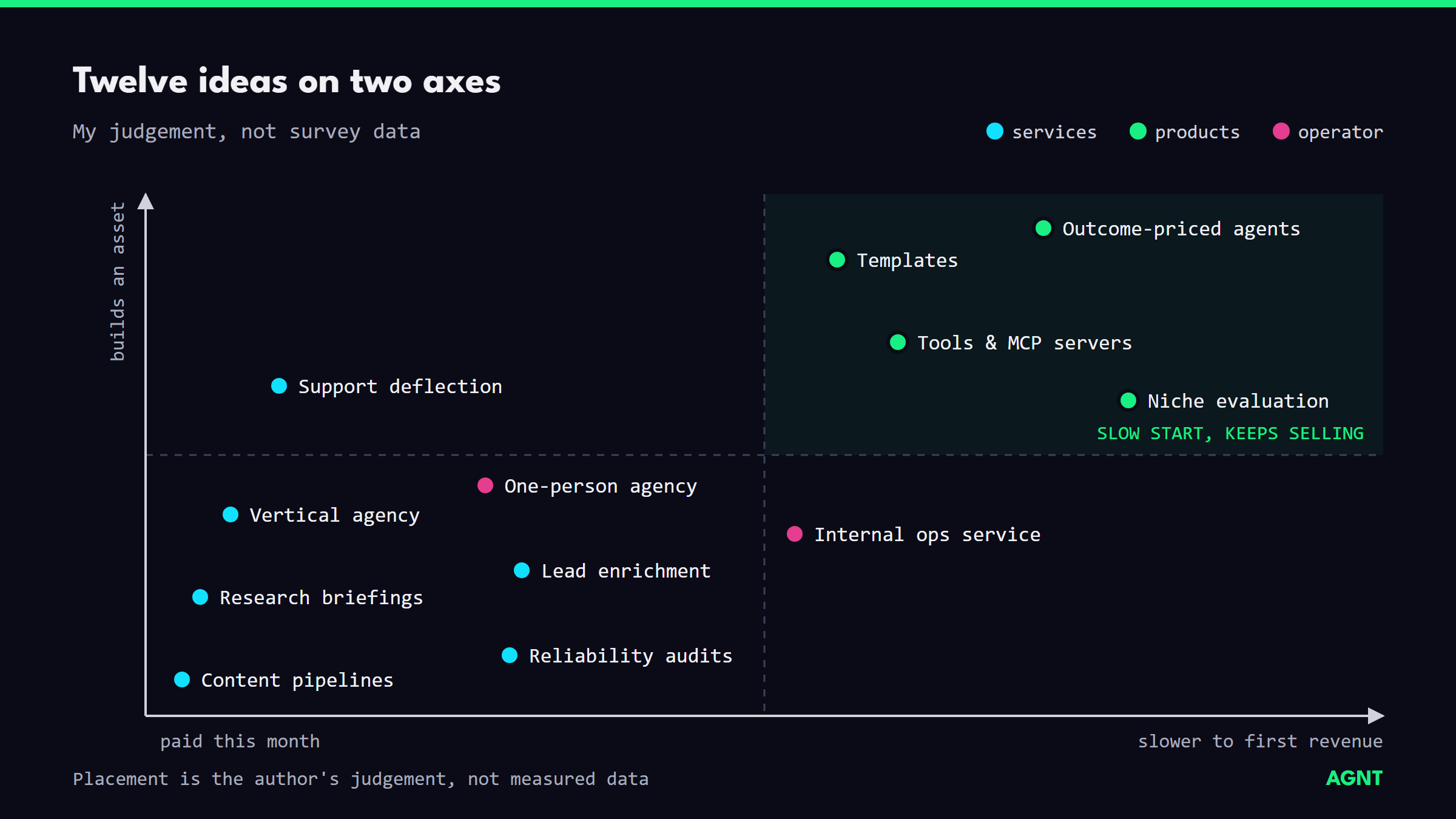
Top right is where I would put a second business, not a first.
How to price agent work
Four models cover most of the market: setup plus retainer, per outcome, per seat, and flat subscription. Sierra argues for paying "only when the software achieves specific, valuable outcomes". That is the easiest model to sell and the hardest to price.
Anthropic found that agents use about 4× the tokens of a chat, and multi-agent systems about 15×. Failed attempts spend those tokens too, so I measure cost per successful outcome before quoting anyone.
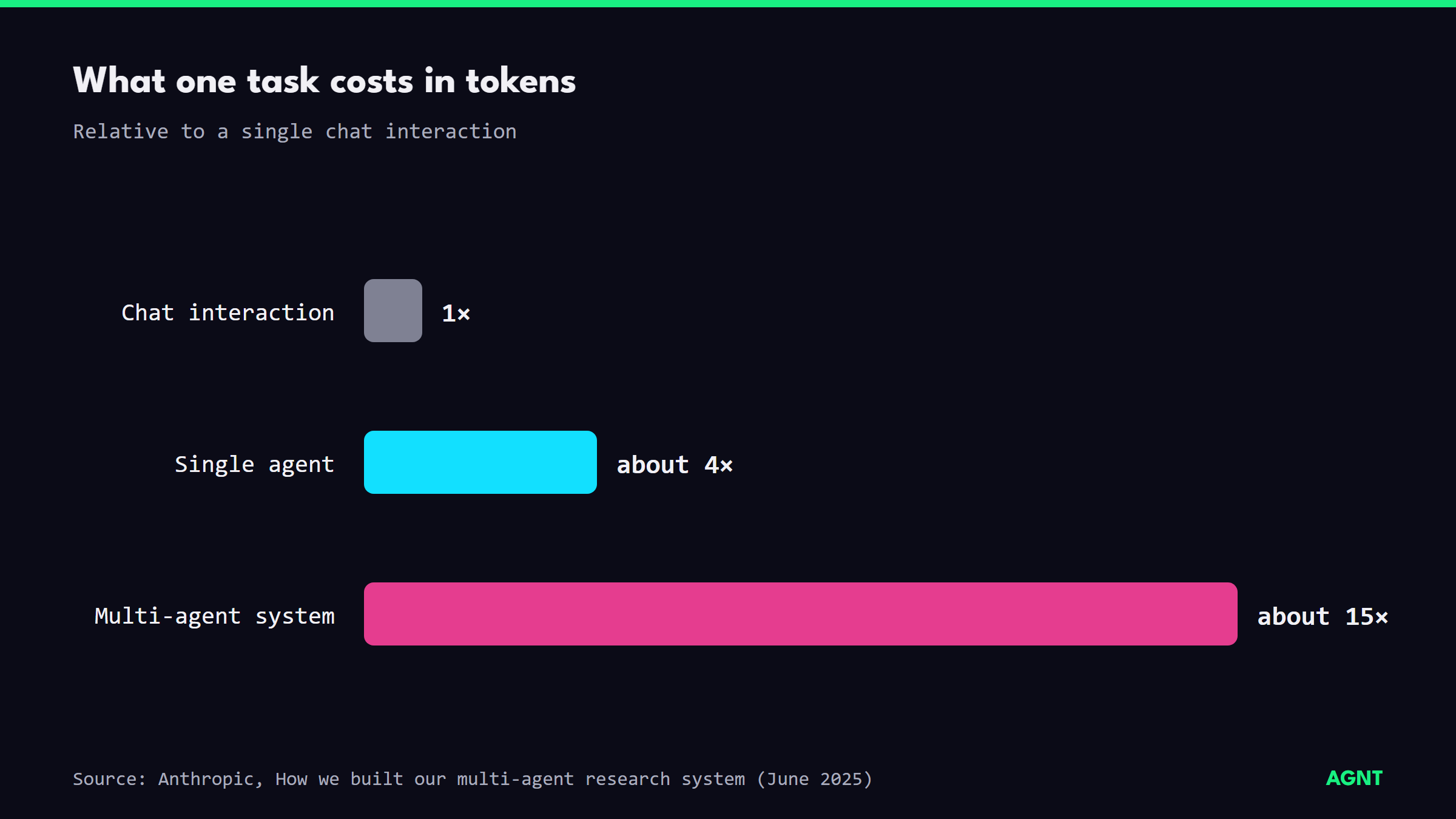
Averages from Anthropic's own research system, not a price list.
Why agent projects get cancelled
Gartner expects over 40% of agentic AI projects to be cancelled by the end of 2027, over "escalating costs, unclear business value or inadequate risk controls". It also estimates that only about 130 of the thousands of agentic AI vendors are real.
LangChain's respondents point at the same weak spot. Quality is their top barrier to production at 32%, yet the tooling runs the other way: 89% watch their agents in production, and only 52.4% test them offline before release.
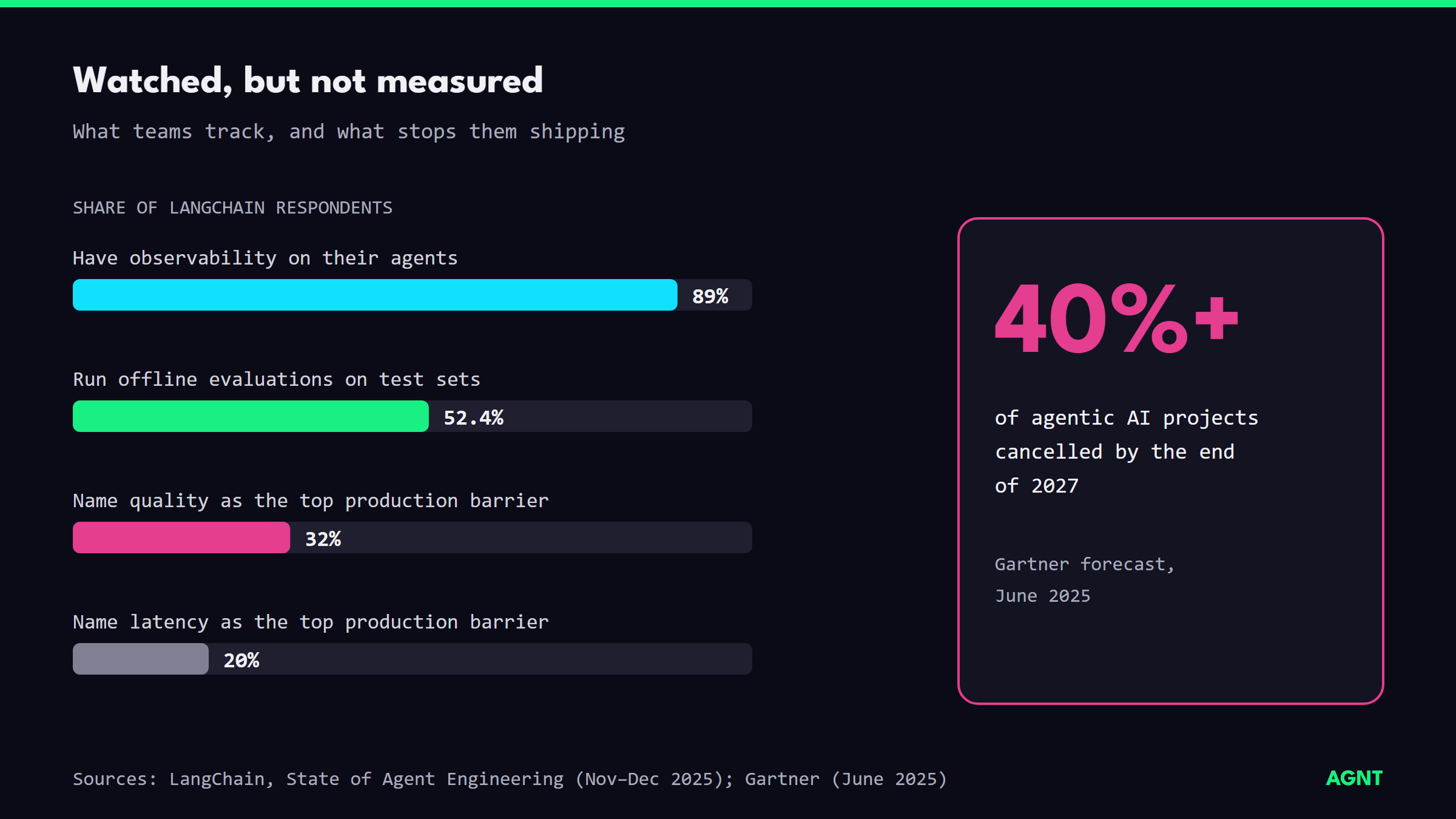
Watching an agent shows what it did. Evaluating it shows whether it was right.
Where this leaves you

Twenty real jobs, scored by hand, before any pricing page. Image: Jakub Żerdzicki / Unsplash.
None of these surveys can give you the number that sets your price: how often your agent gets the job right. Anthropic's research team started its evals with about 20 queries drawn from real usage.
I would do the same before picking an idea. Write down 20 jobs a customer would pay for, run your agent on each, and count the ones you'd put your name to. Your model bill divided by that count is your floor price.
Disclosure: AGNT is our product. It runs agents and workflows on your own machine, which is where I run tests like this one.
Sources
- LangChain, State of Agent Engineering (1,340 responses, fielded Nov–Dec 2025)
- US Census Bureau, Large Firms With at Least 20 Employees Biggest AI Users (May 2026)
- Intercom, Fin pricing, reviewed 26 September 2026
- Sierra, Outcome-based pricing for AI agents (December 2024)
- Anthropic, How we built our multi-agent research system (June 2025)
- Gartner, Over 40% of agentic AI projects will be canceled by end of 2027 (June 2025)