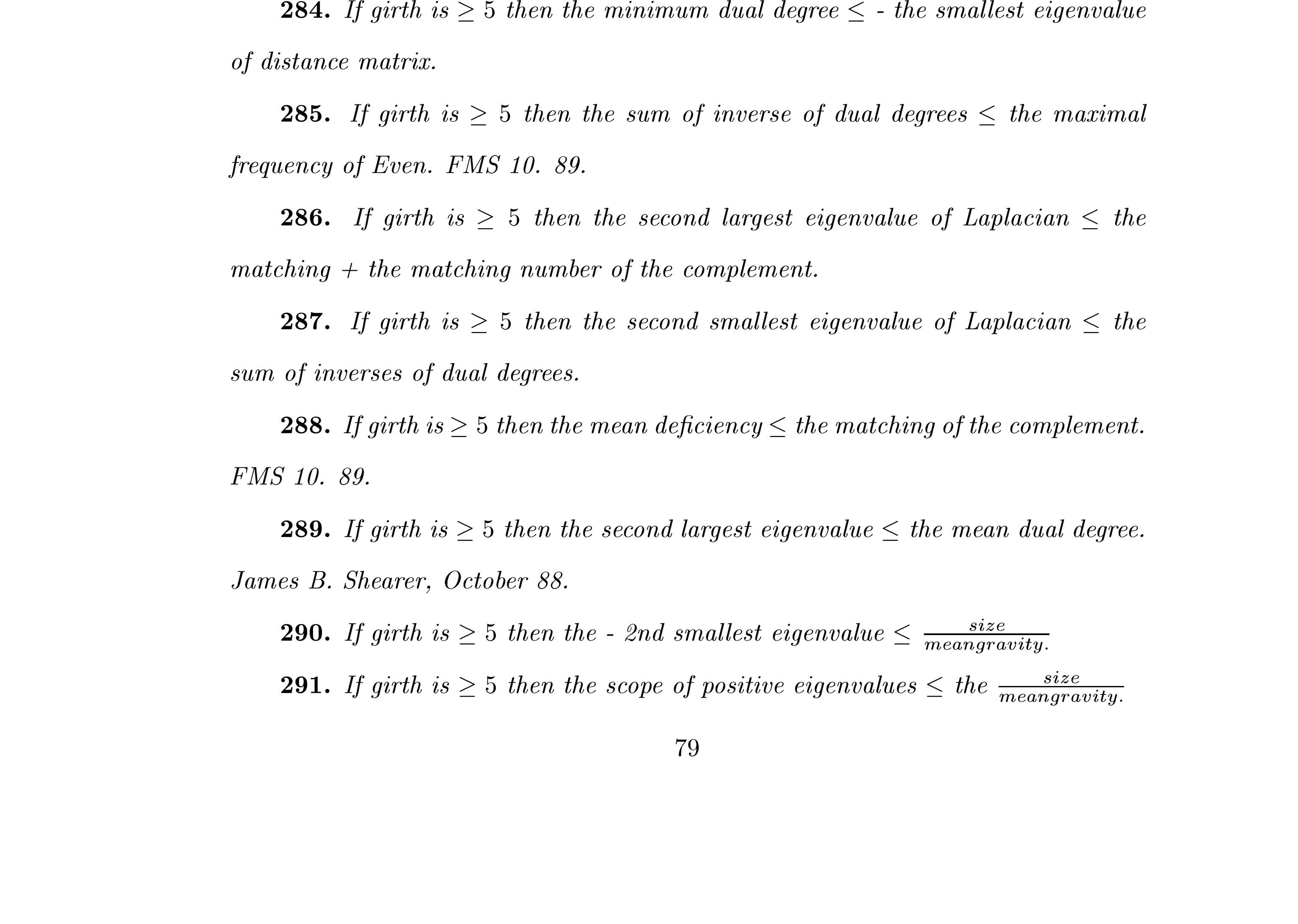
A Proof of Graffiti 290:
Second-Smallest Adjacency Eigenvalues and Size over Mean Gravity
We prove Graffiti 290: for every connected simple graph \(G\) of order \(n\) and girth at least five, \[ -\lambda_{n-1}(A)\;\le\;\frac{m}{\overline{\operatorname{Gr}}}, \] where \(\lambda_{n-1}\) is the second-smallest adjacency eigenvalue, \(m\) is the number of edges, and \(\overline{\operatorname{Gr}}\) is the mean of the gravity matrix over all \(n^2\) entries. The proof actually gives the stronger statement \(\max_i |\lambda_i(A)| \le m/\overline{\operatorname{Gr}}\). The chain is the same three lemmas used for Graffiti 292 — a degree-sum bound on mean gravity, the trace identity \(\operatorname{tr}(A^2)=2m\), and Reiman's \(C_4\)-free edge bound — closed by a quartic \(Q(t)\) whose shift \(Q(u+5)\) has exclusively positive coefficients. Orders \(n\le 7\) are dispatched by exact rational arithmetic. Verification uses four independent batteries — symbolic reduction, exact exhaustive small cases (34 girth-\(\ge 5\) graphs), a named-graph battery including Hoffman–Singleton, and a from-scratch independent reimplementation using LCF-constructed cages, random trees, and random girth-pruned graphs. A shorter uniform argument (§2.5) needs no edge cap, polynomial or small-case check: for girth at least five, both readings of the mean gravity are at most \(1\), and every eigenvalue satisfies \(|\lambda|\le\Delta\le m\). That argument is machine-checked in Lean 4 with Mathlib (§2.6), for both readings of the mean, using only Lean's standard axioms. Novelty is stated provisionally.
1. The conjecture
Let \(G\) be a connected simple graph on \(n\) vertices with adjacency matrix \(A\) and edge set of cardinality \(m\). Its gravity matrix (Brewster–Dinneen–Faber convention, reproduced by Roucairol–Cazenave and used verbatim in our companion Graffiti 292 proof) is
and \(\overline{\operatorname{Gr}}\) is the mean of all \(n^2\) entries. Order the adjacency eigenvalues \(\lambda_1 \ge \lambda_2 \ge \cdots \ge \lambda_n\); the second-smallest is \(\lambda_{n-1}\). Graffiti 290 (page 79 of Fajtlowicz's Written on the Wall, statement verified by direct transcription of the scan) asserts:
As of September 2024 the conjecture was listed open in Roucairol–Cazenave's Table 1 after search algorithms (NMCS, LNMCS, NRPA, UCT, GBFS, BEAM, GRAVE, RAVE) failed to refute it. The paper's erratum notes that the Aouchiche–Hansen gravity convention would make 290 trivially refutable; the Written on the Wall definition (used here) blocks all such counterexamples.
2. The proof
2.1 A degree-sum lower bound for \(m/\overline{\operatorname{Gr}}\)
Proof. Since \(d(u,v)\ge 1\) for \(u \ne v\), \[ \overline{\operatorname{Gr}} =\frac{1}{n^2(n-1)}\sum_{u\ne v}\frac{d(u)d(v)}{d(u,v)} \le\frac{1}{n^2(n-1)}\Bigl(\sum_v d(v)\Bigr)^{\!2} = \frac{4m^2}{n^2(n-1)}, \] and division by \(m\) followed by reciprocation gives the claim. ∎
2.2 The trace bound
Proof. \(\sum_i \lambda_i^2 = \operatorname{tr}(A^2) = 2m\). ∎
2.3 Reiman's extremal edge bound
2.4 Closing the chain
Proof. By Lemma 2 it suffices to prove \(\sqrt{2m}\le m/\overline{\operatorname{Gr}}\); by Lemma 1 it suffices that \(\sqrt{2m}\le n^2(n-1)/(4m)\), i.e. \(n^4(n-1)^2\ge 32 m^3\). The right side is monotone in \(m\), so by Lemma 3 it suffices that \(n^4(n-1)^2 \ge 32 B(n)^3\), which simplifies to \[ 2n(n-1)^2 \ge \bigl(1+\sqrt{4n-3}\bigr)^3.\tag{1} \] Substituting \(t=\sqrt{4n-3}\), \(n=(t^2+3)/4\) and clearing 32 gives \[ 32\bigl(2n(n-1)^2-(1+t)^3\bigr) = (t+1)^2\,Q(t),\qquad Q(t)=t^4-2t^3+4t^2-38t-29. \] Writing \(t=u+5\) yields \[ Q(u+5) = u^4 + 18u^3 + 124u^2 + 352u + 256, \] whose coefficients are all strictly positive, so \(Q(t)>0\) for every \(t\ge 5\), i.e. every \(n\ge 7\). The endpoints \(n=5\) (value \(108-20\sqrt{17}\approx 25.54\)) and \(n=6\) (value \(236-24\sqrt{21}\approx 126.02\)) are strictly positive by exact arithmetic. For \(n\le 7\), all 34 connected girth-\(\ge 5\) graphs are verified exactly (Sturm counts of the adjacency characteristic polynomial roots below the rational bound \(-m/\overline{\operatorname{Gr}}\)). ∎
The terminal quartic is the entire analytic content of the argument:
Q(t) = t^4 - 2 t^3 + 4 t^2 - 38 t - 29
Q(u+5) = u^4 + 18 u^3 + 124 u^2 + 352 u + 256    — all coefficients strictly positive
32(2n(n-1)^2 - (1+t)^3) = (t+1)^2 Q(t)
n=5 endpoint:  108 - 20 sqrt(17)  ≈  25.5379   > 0
n=6 endpoint:  236 - 24 sqrt(21)  ≈  126.0182  > 0
2.5 A uniform argument (added in revision, October 7, 2026)
Proof. Girth at least five rules out triangles and four-cycles. As in §2.5 of the Graffiti 292 paper, this gives \(\sum_v d(v)^2\le n(n-1)\), and Cauchy–Schwarz gives \((2m)^2\le n\sum_v d(v)^2\le n^2(n-1)\). Since \(d(u,v)\ge1\) off the diagonal, \[ \sum_{u\ne v}\operatorname{Gr}_{uv}\;\le\;\frac{1}{n-1}\sum_{u\ne v}d(u)d(v)\;=\;\frac{(2m)^2-\sum_v d(v)^2}{n-1}\;\le\;\frac{(2m)^2-(2m)^2/n}{n-1}\;=\;\frac{(2m)^2}{n}. \] So the mean over all \(n^2\) entries is at most \((2m)^2/n^3\le(n-1)/n<1\), and the off-diagonal mean is at most \((2m)^2/(n^2(n-1))\le1\). An eigenvector's largest coordinate gives \(|\lambda|\le\Delta(G)\), and \(\Delta(G)\le m\). If \(m=0\), every eigenvalue is \(0\) and both sides are \(0\). Otherwise \(0<\overline{\operatorname{Gr}}\le1\), so \(m\le m/\overline{\operatorname{Gr}}\). ∎
2.6 A machine-checked proof in Lean 4 (added in revision, October 7, 2026)
We formalized the argument of §2.5 in Lean 4 with Mathlib. Lean's kernel checks every inference. The source is on GitHub at agnt-gg/graffiti-lean (commit cceea87) and in the archive.
Degree, distance, girth and eigenvalues are Mathlib's own definitions: SimpleGraph.degree, SimpleGraph.dist, the extended girth SimpleGraph.egirth, and Matrix.IsHermitian.eigenvalues₀, the eigenvalues of the real adjacency matrix in decreasing order. Mathlib proves that this list is the sorted list of roots of the characteristic polynomial, with multiplicity. The only new definitions are the gravity matrix and its means. The main statement reads:
noncomputable def gravity (G : SimpleGraph α) [DecidableRel G.Adj] (u v : α) : ℝ :=
  if u = v then 0
  else (G.degree u * G.degree v : ℝ) / ((Fintype.card α - 1 : ℝ) * G.dist u v)

noncomputable def meanGravity (G : SimpleGraph α) [DecidableRel G.Adj] : ℝ :=
  (∑ u, ∑ v, G.gravity u v) / (Fintype.card α : ℝ) ^ 2

theorem graffiti_290 {α : Type*} [Fintype α] [DecidableEq α] (G : SimpleGraph α)
    [DecidableRel G.Adj] (hconn : G.Connected) (hgirth : 5 ≤ G.egirth)
    (hn : 2 ≤ Fintype.card α) :
    -(G.isHermitian_adjMatrix ℝ).eigenvalues₀ ⟨Fintype.card α - 2, by omega⟩ ≤
      G.edgeFinset.card / G.meanGravity
| Theorem | Statement |
|---|---|
graffiti_290 | Graffiti 290, with the mean over all \(n^2\) entries of the gravity matrix. |
graffiti_290.variants.off_diagonal_mean | Graffiti 290, with the mean over the \(n(n-1)\) off-diagonal entries. |
graffiti_290.variants.abs_le | Every eigenvalue: \(|\lambda|\le m/\overline{\operatorname{Gr}}\), without connectivity. |
Fidelity to the source.
- Statement. Page 79 reads "If girth is ≥ 5 then the − 2nd smallest eigenvalue ≤ size / meangravity." The size of a graph is its number of edges.
- Second-smallest eigenvalue.
eigenvalues₀is indexed from \(0\) in decreasing order, so \(\lambda_{n-1}\) has index \(n-2\). The hypothesis \(n\ge2\) makes it exist. - Gravity. On p. 52 an entry is \(0\) when no path joins \(u\) and \(v\). Mathlib's
distis \(0\) for such a pair and Lean defines \(x/0=0\), so the Lean entry is also \(0\). - Eigenvalues and connectivity. Eigenvalues are those of the adjacency matrix unless stated otherwise (p. 1), and conjectures that involve distance are only for connected graphs (p. 2). Hence the hypothesis
G.Connected. - Girth. An acyclic graph has
egirth = ⊤, so it satisfies the girth hypothesis, as trees do in the source. - Mean. The source does not define the mean of a matrix, so both readings are proved.
What was checked.
- The project builds with
lake buildon Lean v4.33.1 with Mathlib v4.33.1 (commit0df444a), with warnings treated as errors. - For all three theorems,
#print axiomsreports onlypropext,Classical.choiceandQuot.sound, Lean's standard axioms. There is nosorry, no custom axiom and nonative_decide. - Negative controls: with the girth hypothesis weakened from 5 to 4, the proof fails; with the gravity bound tightened from \((2m)^2/n\) to \((2m)^2/n^2\), which \(K_2\) violates, the proof fails.
- Battery 5 checks every inequality of §2.5 in exact rational arithmetic on 345 graphs of girth at least five, including all 34 connected ones with \(n\le7\). The bound \(\sum\operatorname{Gr}\le(2m)^2/n\) holds with equality for \(K_2\).
As with any Mathlib proof, this check trusts the Lean kernel and the Mathlib definitions above. Mathlib's prebuilt library files were loaded, not rebuilt from source.
3. Verification architecture
Six verification batteries. Batteries 1–4 check the argument of §§2.1–2.4, with no shared code between the primary certifiers and the independent reimplementation. Battery 5 checks the uniform argument of §2.5, and battery 6 is the Lean kernel (§2.6). A failure at any battery would block publication.
| Battery | Method | Coverage | Status |
|---|---|---|---|
| 1. Named-graph battery | exact gravity means (rational) + numeric spectra | C₅, C₆, C₇, Petersen, Heawood, Pappus, Desargues, Möbius–Kantor, dodecahedron, Hoffman–Singleton, path P₁₀, star K₁,₉, spider (3,3,3), McGee 7-cage, Tutte–Coxeter 8-cage | PASS |
| 2. Symbolic reduction | SymPy exact factorization | factorization \((t+1)^2 Q(t)\), shifted coefficients [1, 18, 124, 352, 256], exact endpoints n=5, 6 | PASS |
| 3. Exhaustive exact small cases | exact rational gravity + Sturm root counts of adjacency characteristic polynomial | all 34 connected girth ≥ 5 graphs with 2 ≤ n ≤ 7 from the graph atlas | PASS |
| 4. Independent reimplementation | from-scratch: LCF cages, hand-rolled Hoffman–Singleton (pentagon/pentagram), separate gravity accumulator | HS, Petersen, Heawood, C₅, K₂, K₁,₂₀, McGee, Tutte–Coxeter, 60 random trees (2 ≤ n ≤ 60), 40 random girth-pruned graphs | PASS |
| 5. Uniform bound | exact rational gravity sums, numeric spectra | 345 girth ≥ 5 graphs: 11 named, all 34 connected ones with n ≤ 7, 300 random; every inequality of §2.5 | PASS |
| 6. Formal proof | Lean 4 kernel with Mathlib | the uniform argument of §2.5 for every graph of girth at least five, both readings of the mean; standard axioms only | PASS |
4. Exact certificates
4.1 Named-graph margins
Every entry is derived from an exact rational gravity mean; the last column reports the certified inequality margin \(m/\overline{\operatorname{Gr}} - (-\lambda_{n-1})\). Positive means the bound holds; the strong pattern is that the margin grows quickly with \(n\).
| Graph | n | m | −λₙ₋₁ | m / Gr | margin |
|---|---|---|---|---|---|
| C₅ | 5 | 5 | 1.6180 | 8.333 | +6.715 |
| C₆ | 6 | 6 | 1.0000 | 13.500 | +12.500 |
| C₇ | 7 | 7 | 1.8019 | 20.045 | +18.244 |
| Petersen | 10 | 15 | 2.0000 | 25.000 | +23.000 |
| Heawood (6-cage) | 14 | 21 | 1.4142 | 57.909 | +56.495 |
| Möbius–Kantor | 16 | 24 | 1.7321 | 80.842 | +79.110 |
| Pappus | 18 | 27 | 1.7321 | 108.000 | +106.268 |
| Desargues | 20 | 30 | 2.0000 | 141.527 | +139.527 |
| McGee (7-cage) | 24 | 36 | 2.3429 | 210.286 | +207.943 |
| Tutte–Coxeter (8-cage) | 30 | 45 | 2.0000 | 362.500 | +360.500 |
| Hoffman–Singleton | 50 | 175 | 3.0000 | 312.500 | +309.500 |
4.2 The exhaustive small-order check
All 34 connected simple graphs of order \(2\le n\le 7\) with girth at least five (path graphs, trees of every shape, C₅, C₆, C₇, and the small trees on 7 vertices) are enumerated from NetworkX's graph atlas. For each graph, the gravity mean is computed as an exact rational number \(m/\overline{\operatorname{Gr}}\in\mathbb{Q}\), and the adjacency characteristic polynomial is passed to SymPy's Sturm-based root counter to count roots strictly below \(-m/\overline{\operatorname{Gr}}\). The inequality \(-\lambda_{n-1}\le m/\overline{\operatorname{Gr}}\) holds exactly when at most one root lies strictly below \(-m/\overline{\operatorname{Gr}}\). In all 34 graphs, no root lies there.
4.3 Independent reimplementation highlights
The Battery 4 script constructs the Hoffman–Singleton graph by the classical pentagon/pentagram recipe — five pentagons \(P_h\), five pentagrams \(Q_h\), with joins \(P_{h,i} \sim Q_{k,\,hk+i\bmod 5}\) — and separately verifies via A² and A³ that the graph is 7-regular, triangle-free, C₄-free, and contains a 5-cycle (hence girth 5). It uses its own gravity accumulator (no reuse of Battery 1's code) and its own path/cage constructions via LCF notation. Every check for 290 passes, including on 60 random trees generated by networkx.random_labeled_tree and 40 random girth-pruned graphs.
5. Companion result and mechanism sharing
Graffiti 290 falls out of the exact chain that settles Graffiti 292 (companion whitepaper, a-proof-of-graffiti-292.html). Because the 292 terminal already proves \(n/\overline{\operatorname{Gr}} \ge \sqrt{2m}\) for \(n\ge 7\), whenever \(m \ge n\) the 290 target \(m/\overline{\operatorname{Gr}}\) exceeds \(n/\overline{\operatorname{Gr}}\ge\sqrt{2m}\ge |\lambda|\) automatically. The quartic \(Q(t)\) above absorbs the remaining sparse cases (trees, forests, unicyclic girth-\(\ge 5\) graphs where \(m Dependencies: Python 3.13, SymPy 1.14, NetworkX 3.5, NumPy 2.3; for §2.6, Lean v4.33.1 and Mathlib v4.33.1, both pinned in the Lean files. Exact arithmetic on the decisive rung; floating point is only used for numeric spectra in the named-graph table. AGNT Labs publishes its working out. The same discipline runs through the product: every agent run produces a receipt showing what it did, what it read, and why — so a result can be checked rather than trusted. AGNT runs on your own machine and is free to use.6. Novelty status — stated provisionally
7. Reproduction protocol
python -m pip install sympy networkx numpy
python verify_290_symbolic.py         # factorization, shift positivity, endpoints
python verify_290_small_cases.py      # exhaustive n≤7, exact rational gravity, Sturm counts
python independent_check_284_290.py   # independent reimplementation, 60 trees + 40 pruned
python battery_290.py                 # uniform bound (§2.5): 345 graphs, exact rational sums

# Lean (§2.6): in the lean/ folder of the archive, or a clone of agnt-gg/graffiti-lean
lake exe cache get                    # prebuilt Mathlib
lake build                            # checks the proofs and prints their axioms
8. Artifact ledger
Artifact Purpose manuscript-graffiti-290.md Markdown proof with full derivations verify_290_symbolic.py · output Symbolic reduction: (t+1)²Q(t), shift positivity, endpoints verify_290_small_cases.py · output Exhaustive small-case + named-graph batteries (exact rational gravity, Sturm root count) independent_check_284_290.py · output Independent reimplementation (shared with the 284 refutation package) battery_290.py · output Uniform bound (§2.5): exact checks on 345 graphs agnt-gg/graffiti-lean · archived copy Lean 4 proof (§2.6), with the shared gravity definitions and lemmas claim-ledger.json Claim-by-claim evidence map (covers 290 proof + 284 refutation verification + 295 attack state) wow-p79-bot.png Primary source scan of the page-79 conjecture statement SHA256SUMS.txt Integrity ledger References
This is what the product is for